If you’ve seen a robot vacuum advertised as “2-in-1 vacuum and mop,” it’s natural to wonder what that actually means in practice. Does it mop the way a person does? Is it safe on every floor? Does a vibrating pad really clean better than a simple damp one? This guide explains what robot vacuum mop features generally do, how they tend to vary from one model to the next, and what beginners should check before relying on one.
Table of Contents
- Quick Answer
- What Robot Vacuum Mop Features Are Designed to Do
- The Basic Mop Pad and Water Tank Setup
- Water Flow and Water Level Control
- Vibrating, Lifting, and Other Pad Motion Types
- How Robot Mopping Differs From Manual Deep Mopping
- Floor-Type Cautions You Should Know
- Rugs, Carpets, and Mop Avoidance
- Mop Pad Cleaning, Drying, and Replacement
- Common Beginner Misunderstandings
- When Mop Features May Not Be Enough
- Simple Checklist Before You Rely on Mopping
- Frequently Asked Questions
- Final Takeaway
Quick Answer
- Most robot vacuums with mop features use a removable or attached pad together with a small onboard water tank to lightly dampen and wipe hard floors.
- These mop features are generally designed for light, routine wiping, not deep cleaning or stain removal.
- Exactly how water flow and pad motion work, and which floors are safe, depends on the specific model — always check your manual before relying on it.
What Robot Vacuum Mop Features Are Designed to Do
Robot vacuum mop features are generally intended for everyday dust, light dirt, and fresh, light spills on hard floors — not for deep or stuck-on messes. In most designs, the mopping function works alongside the robot’s normal dry vacuuming pass rather than replacing it; the robot vacuums first and mops as a secondary step.
It helps to think of robot vacuum mop features as a maintenance convenience rather than a substitute for occasional manual deep mopping. They can keep floors generally tidy between more thorough cleanings, but they are not built to replace the kind of attention a person gives a sticky kitchen floor or a muddy entryway.
The Basic Mop Pad and Water Tank Setup
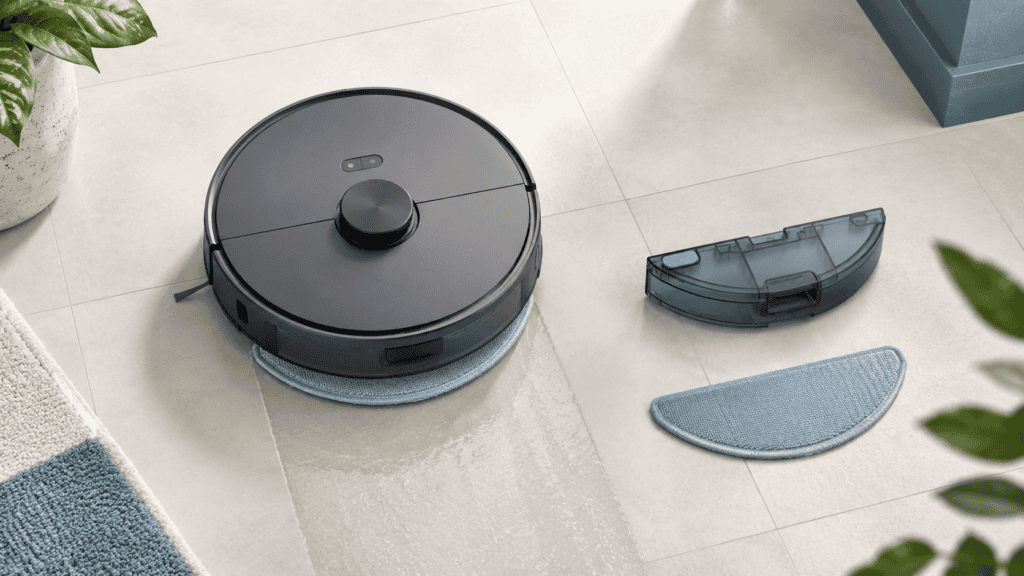
Across most manufacturers, the basic mechanism behind how robot vacuum mop pads work is similar: a removable or attached fabric pad holds moisture against the floor, and a small onboard water tank supplies that moisture, usually through an internal pump. As the robot moves, the dampened pad wipes the floor surface.
What varies from model to model is the tank size, the way the pad attaches (a snap-on plate, a dock-based pad change, and so on), and the pad material itself. Some pads are reusable cloth, while others are designed to be used once and thrown away. Because of this variation, it’s worth checking your own model’s manual rather than assuming your robot’s setup matches what another brand does.
Water Flow and Water Level Control
Many robot vacuum mop systems let you adjust how much water reaches the pad, often through a companion app or a physical setting on the robot or dock. A lower water setting is generally suggested for water-sensitive floors, and a higher setting for tougher, drier dirt — but the exact number of levels, and how they’re labeled, depends on the model.
Some robots also automatically stop water flow in certain situations, such as when the robot is paused or when it detects it’s about to cross onto carpet. More water is not automatically better; using more moisture than a floor can handle is itself a risk, which is covered in more detail in the floor-type section below.
Vibrating, Lifting, and Other Pad Motion Types
This is one of the areas where robot vacuum mop systems differ the most. Some models use a simple, static damp pad that just rests against the floor as the robot moves. Others add a vibrating or scrubbing motion intended to help loosen light residue. Still others can automatically lift the pad off the floor — for example, when the robot senses it’s about to cross onto carpet — so that it avoids wetting that area.
None of these approaches is established here as universally better than the others; they’re different engineering choices, and there isn’t reliable, independent evidence comparing them head-to-head across brands. The table below summarizes the general idea behind each approach without ranking them against one another.
| Feature type | What it generally does | What to be careful about |
|---|---|---|
| Static damp pad | Keeps a pad lightly moistened as it wipes the floor | Less effective on anything beyond light dust or fresh spills |
| Vibrating or scrubbing pad | Adds motion intended to help loosen light residue | A vibrating motion does not guarantee a deeper clean; results still depend on debris type and floor condition |
| Pad that lifts over carpet | Raises the pad and usually stops water flow when carpet is detected | Carpet detection is model-dependent — not every robot has this, so check before assuming your floor mix is fully covered |
How Robot Mopping Differs From Manual Deep Mopping
Robot mopping is generally built around light, hands-free routine maintenance, while manual mopping remains more effective for heavy grime, dried-on spills, or detailed cleaning in corners and along edges. Robot mop pads are usually smaller and apply less pressure than a person mopping by hand, so they tend to cover ground evenly rather than scrubbing intensively in any one spot.
In practice, many households use a robot’s mop feature for routine, everyday upkeep and still mop manually on a less frequent schedule for a deeper clean. Robot mopping and manual mopping aren’t really competing for the same job — they’re suited to different kinds of messes.
Floor-Type Cautions You Should Know
This is the most important caution area to understand before relying on a robot’s mop feature. Unsealed or water-sensitive wood and laminate floors can warp, swell, or otherwise be damaged by excess moisture over time. A sealed hard floor — a floor with a protective coating designed to resist moisture, such as sealed wood, properly sealed laminate, tile, or vinyl — is generally more tolerant of light dampness, but you shouldn’t assume your floor is sealed just because it looks finished.
Caution: Robot mops are not safe for every floor type. Before relying on automated mopping, check both your robot’s manual and your flooring manufacturer’s care guidance — especially if you have wood or laminate floors of uncertain or unconfirmed sealing.
If you’re unsure how your home’s floors are generally categorized, SmartCleanLab’s guide to robot vacuum floor types walks through hard floors, rugs, and carpets in more depth.
Rugs, Carpets, and Mop Avoidance
Carpet handling is its own separate consideration from floor-type safety. Some robot vacuums can detect rugs or carpets and avoid mopping over them, either through onboard sensors or by mechanically lifting the mop pad. Others have no built-in detection at all and instead rely on the user to set up physical or virtual boundaries to keep the robot away from carpeted areas while mopping.
Caution: Not every robot vacuum with a mop feature avoids carpets automatically. If your home has a mix of hard floors and rugs, check specifically whether your model handles this on its own or requires you to set boundaries manually.
Mop Pad Cleaning, Drying, and Replacement
Reusable mop pads generally need regular washing — by hand or in a washing machine, depending on what the manufacturer recommends — and are usually meant to be air-dried rather than machine-dried unless the instructions say otherwise. Some higher-tier docks can automatically rinse and dry pads as part of their cleaning cycle, but this is a feature found on some models, not a universal standard.
Pads also wear out with use and eventually need replacing; exactly how often depends heavily on your model and how frequently you mop, so it’s worth checking your manufacturer’s guidance rather than assuming a fixed schedule. For a broader look at how often different robot vacuum parts typically need attention, see SmartCleanLab’s guide on replacing robot vacuum parts.
Tip: Only use a cleaning solution in the water tank if your manufacturer’s instructions specifically allow it. A solution approved for one robot’s tank is not automatically safe for another model.
Common Beginner Misunderstandings
A few assumptions trip up a lot of first-time robot mop owners:
- “2-in-1 vacuum and mop” doesn’t mean both functions perform equally well or substitute for each other’s strengths — they’re handling different kinds of cleaning.
- A vibrating pad or a higher water-flow setting isn’t automatic proof of a deeper clean; results depend on several factors working together, not any single spec.
- Just because one manufacturer says a certain cleaning solution is safe for its tank doesn’t mean any solution is safe to pour into any robot’s tank.
When Mop Features May Not Be Enough
Dried, sticky, or greasy messes are generally handled less reliably by routine robot mopping than by a manual cleanup with some elbow grease. A mop feature also can’t compensate for a problem on the vacuum side of the machine — for example, a full dustbin or a dirty filter can affect a robot’s overall cleaning performance regardless of how well its mop pad is working.
It’s also worth remembering that suction power and mopping performance are separate systems — a robot with a strong mop feature doesn’t necessarily vacuum strongly, and vice versa. They’re worth thinking about independently when you’re trying to understand what a robot vacuum can realistically do for your home.
Simple Checklist Before You Rely on Mopping
- Confirm your floor type is approved for mopping in your model’s manual.
- Confirm whether your model handles carpets and rugs automatically or needs manual boundary setup.
- Confirm the pad-cleaning method — hand wash, machine wash, or dock-based — and set a realistic check-in schedule for replacement.
- Confirm whether any cleaning solution is approved for your specific model before adding one to the tank.
Frequently Asked Questions
Can a robot vacuum mop replace regular manual mopping?
Not entirely. Robot mop features are generally suited to light, routine wiping, while manual mopping tends to be more effective for heavier grime, dried spills, or detailed corner cleaning. Many people use both — automated mopping for everyday upkeep and manual mopping less often for a deeper clean.
Are robot vacuum mops safe to use on hardwood or laminate floors?
It depends on whether the floor is properly sealed and on what your specific robot’s manual says. Unsealed or water-sensitive wood and laminate floors can be damaged by excess moisture, so it’s worth checking both your robot’s documentation and your flooring manufacturer’s guidance before relying on automated mopping on these surfaces.
Do robot vacuum mops work on carpets and rugs, or do they avoid them?
This depends on the model. Some robots can detect carpets and rugs and either avoid them or lift the mop pad automatically. Others have no built-in detection and need the user to set up boundaries manually so the robot doesn’t mop over carpeted areas.
What does adjustable water flow actually control?
It controls how much moisture reaches the mop pad while cleaning. Lower settings are generally meant for more water-sensitive floors, and higher settings for tougher dirt, but more water doesn’t automatically mean a better clean — using too much moisture for a given floor can actually be a risk.
Do vibrating or spinning mop pads clean better than a simple damp pad?
Not necessarily. These are different design approaches rather than a clear upgrade path, and there isn’t reliable, independent evidence showing that any one pad-motion type consistently outperforms the others across brands and conditions.
How often should a robot vacuum’s mop pad be cleaned or replaced?
This varies quite a bit by model and how often you mop, so there isn’t one fixed schedule that applies to every robot. Checking your manufacturer’s guidance — and keeping an eye on visible wear or odor — is more reliable than following a generic interval.
Can I use any cleaning solution in a robot vacuum’s water tank?
Generally, no. Solution compatibility is specific to each manufacturer, and using an unapproved solution could damage the robot or void its warranty. Stick to whatever your specific model’s instructions say is safe for its tank.
Does a strong mop feature mean the robot also vacuums better?
No. Vacuuming (suction, brushes, airflow) and mopping (pad, water tank, water flow) are separate systems on a combination robot. A robot can be strong in one area and average in the other, so it’s worth evaluating both separately rather than assuming one implies the other.
Final Takeaway
Robot vacuum mop features can be a genuine convenience for light, routine floor care, but they’re not a deep-cleaning replacement for manual mopping. Mop pad design, water flow control, and carpet handling all vary by model, and floor-type safety depends on your specific floor and your manufacturer’s guidance — not on assumptions. The safest way to use a mop feature is to check your own model’s manual for floor-type approval, carpet handling, and pad care, and to keep up with basic maintenance like pad cleaning and timely replacement. No single mop mechanism is presented here as the best choice — the goal is to help you use the feature you already have safely and realistically.