Many owners wonder how often to replace robot vacuum parts, but a robot vacuum does not have one universal replacement schedule that fits every home. Some parts may only need a quick cleaning, while others may eventually need replacement once they are worn, clogged, or damaged.
This guide explains how beginners can think about robot vacuum replacement parts: which areas are worth checking, what wear actually looks like, and why cleaning a part is usually worth trying before replacing it. It does not give a fixed month-by-month replacement calendar, because that kind of schedule does not hold up well across different models, homes, and usage patterns.
Table of Contents
- Why There Is No Universal Replacement Schedule
- What Affects How Fast Robot Vacuum Parts Wear Out
- Robot Vacuum Parts Beginners Should Check Regularly
- Signs a Part May Need Cleaning or Replacement
- What to Clean Before You Replace a Part
- How Manufacturer Guidance Should Be Used
- Beginner Checklist for Robot Vacuum Replacement Parts
- Frequently Asked Questions
- Final Takeaway
Why There Is No Universal Replacement Schedule
Robot vacuum parts wear at different rates depending on the model, how often the robot runs, the flooring in your home, dust levels, pet hair, and the manufacturer’s own design and guidance. A robot that runs daily in a home with pets and hard floors will likely show wear on its brushes and filter much sooner than one that runs a few times a week in a smaller, low-traffic apartment.
Because of this, a single fixed number — like “replace the filter every two months” — may work for one household and be far too frequent or too infrequent for another. The most reliable approach is to check parts regularly for visible wear and to follow the guidance provided for your specific model rather than a generic online schedule.
What Affects How Fast Robot Vacuum Parts Wear Out
Several practical factors can speed up or slow down how quickly robot vacuum parts wear out:
- How often the robot runs each week
- Hard floors versus carpets, since carpet fibers can wear brushes faster
- Pet hair and long human hair, which can tangle around brushes and wheels
- Overall dust and debris levels in the home
- Moisture from mopping, if the robot has a mopping function
- Whether parts are cleaned regularly or left until they are visibly clogged
- Manufacturer-specific design choices, since brush, filter, and battery designs differ between models
None of these factors guarantee a specific wear rate on their own, but together they explain why two households with similar robot vacuums can end up needing maintenance at noticeably different times.
Robot Vacuum Parts Beginners Should Check Regularly
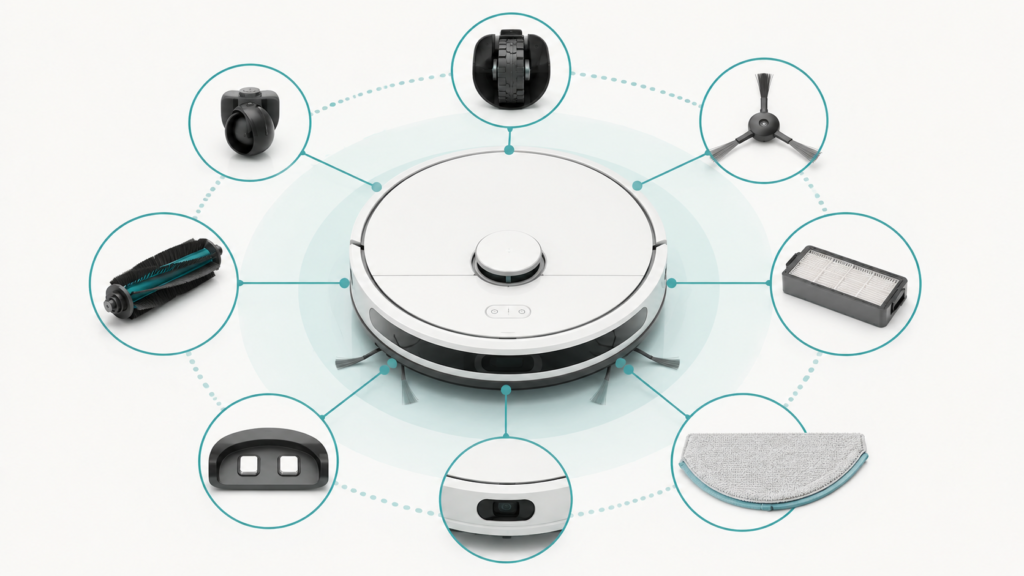
The parts below are common across most robot vacuums, though not every model has every part listed here. For each one, checking its condition is more useful than assuming a fixed replacement date.
| Part | What to Look For |
|---|---|
| Main Brush | Bent, frayed, or worn bristles after removing trapped hair |
| Side Brush | No longer sweeps debris effectively even after cleaning |
| Filter | Stays dusty, discolored, or stiff even after cleaning |
| Mop Pad | Wears thin, smells persistently, or loses contact with the floor |
| Wheels, Sensors & Charging Contacts | Usually cleaning points rather than replacement — watch for visible physical damage |
| Battery | Shorter runtime, failure to fully charge, or unexpected shutdowns |
Main Brush or Brush Roll
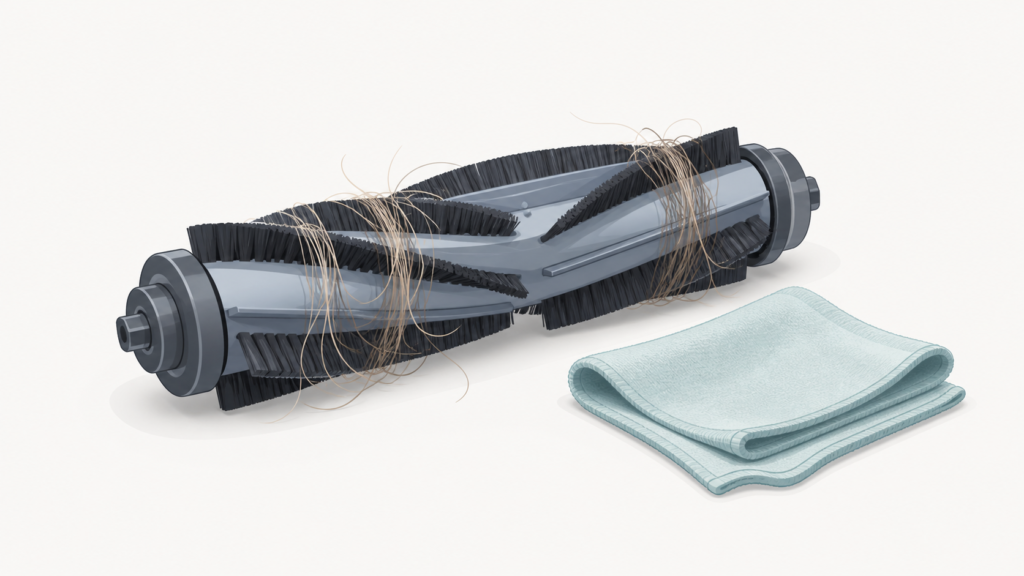
The main brush, sometimes called the brush roll, is usually the primary part responsible for lifting dirt and debris from the floor. Hair and fibers can wrap tightly around it over time, and the bristles or rubber fins can become bent, frayed, or worn down with regular use. Before assuming a brush needs replacing, it is worth removing trapped hair and checking whether the bristles or fins still look intact. If the brush still looks visibly worn or damaged after cleaning, that is a more useful signal than a calendar date, and checking your manufacturer’s guidance for your specific model can help confirm whether replacement is recommended.
Side Brush
Many robot vacuums use a smaller side brush to sweep debris from edges and corners toward the main cleaning path. Like the main brush, it can collect tangled hair, and its bristles can become bent, frayed, or occasionally missing altogether. A side brush that no longer sweeps debris effectively, even after a thorough cleaning, may be a candidate for replacement, but this depends on the individual robot’s condition rather than a fixed interval.
Filter
The filter helps capture fine dust and debris before air is released back into the room. Over time, filters can become clogged with dust, which may reduce suction performance. Some filters are washable and some are not, so it is worth checking your manufacturer’s documentation before attempting to rinse one. If a filter remains visibly dusty, discolored, or stiff after cleaning (when cleaning is supported), that can be a sign it may need replacing.
Mop Pad
If your robot has a mopping function, the mop pad is the part that applies water or cleaning solution to hard floors. Mop pads can wear thin, develop a persistent odor even after washing, or stop making even contact with the floor. Reusable cloth pads and disposable pads have different care needs, so checking what your model recommends is worthwhile before deciding whether a pad needs to be replaced.
Wheels, Sensors, and Charging Contacts
These three areas are usually better thought of as cleaning and inspection points rather than parts that need frequent replacement. Wheels can collect hair, string, or grit that affects traction and makes the robot more likely to get stuck. Sensors, which support obstacle detection and, on some models, mapping, can be affected simply by dust or smudges on their surface — wiping them periodically with a dry or slightly damp microfiber cloth is generally enough, and persistent navigation issues are usually worth investigating through cleaning first. Charging contacts on both the robot and the dock can develop a buildup of dust or light corrosion that weakens the connection; wiping them is typically all that is needed to restore reliable charging. Replacement of these specific parts is comparatively rare unless there is visible physical damage.
Battery
The battery deserves a more careful approach than the other parts on this list. Most robot vacuums use a rechargeable lithium-ion battery, and it is normal for runtime to gradually decrease over time as the battery ages. Signs that may suggest a battery issue include noticeably shorter runtime than before, the robot failing to reach a full charge, charging that takes much longer than usual, or the robot stopping unexpectedly during a cleaning run. Heat, frequent deep discharges, and long periods stored at a full charge can all accelerate battery wear. If a battery ever appears swollen or visibly damaged, that should be treated as a safety concern rather than a routine wear sign, and the manufacturer’s support guidance should be checked before continuing to use it. There is no single fixed number of years or charge cycles that applies to every battery in every robot, so changes in everyday performance are a more practical guide than a countdown.
Signs a Part May Need Cleaning or Replacement
Some general signs can suggest that a part may benefit from attention, though none of them prove on their own exactly which part is responsible:
- More debris left behind on the floor than usual
- Hair repeatedly wrapping around the main brush or side brush
- Brush bristles or rubber fins that look bent, frayed, or damaged
- A filter that stays clogged or dusty even after cleaning
- A mop pad that smells or no longer sits flush against the floor
- A side brush that no longer sweeps edges effectively
- Charging that becomes unreliable even after the contacts have been cleaned
When one or more of these signs appear, it is usually more useful to start with cleaning and inspection than to assume a part automatically needs to be replaced.
What to Clean Before You Replace a Part
Cleaning a part is often worth trying before assuming it needs to be replaced, since many performance issues are caused by buildup rather than permanent wear. The brush roll and side brush usually benefit from having tangled hair removed and being checked for damage. For brush care specifically, see our guide on how to clean robot vacuum brushes, which covers the cleaning process in more detail.
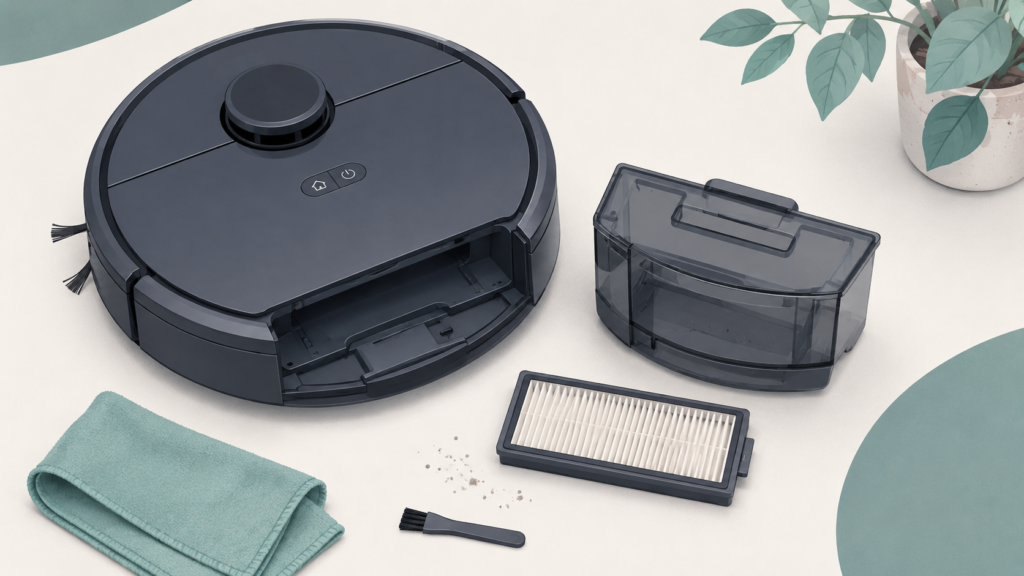
Beyond the brushes, the dustbin can usually be emptied and wiped out, sensors can be wiped with a dry or slightly damp microfiber cloth, and charging contacts can be cleaned to restore a reliable connection. The filter can sometimes be cleaned as well, but only if the manufacturer specifically describes it as washable — treating a non-washable filter as if it were reusable can damage it rather than extend its life. The same caution applies to mop pads: if the manufacturer describes the pad as washable, rinsing and air-drying it is usually appropriate, but not every pad type is designed to be reused indefinitely.
How Manufacturer Guidance Should Be Used
Manufacturer manuals and official support pages exist for a reason: they reflect the specific design of your model, including which parts are washable, how often the manufacturer suggests checking certain components, and how to access parts safely. This guidance can be genuinely useful, especially for model-specific details that a general article cannot account for.
At the same time, one manufacturer’s suggested interval for one model should not be treated as a universal rule for every robot vacuum. Different brands and even different models from the same brand can have different design choices, filter types, and recommended care steps. The most balanced approach is to use manufacturer guidance as the most reliable source for your specific robot, while still relying on visible wear signs and cleaning results to make day-to-day decisions.
Beginner Checklist for Robot Vacuum Replacement Parts
A simple, practical checklist can help beginners decide when to inspect or clean a part rather than guessing:
- Check the manual or official support page for your specific model.
- Clean the part first when it is safe to do so.
- Look for visible wear, such as cracks, missing bristles, or reduced contact with the floor.
- Pay attention to repeated performance changes rather than a single off day.
- Avoid replacing a part only because a generic online schedule says so, without checking its actual condition.
- When replacement is needed, use parts that are compatible with your specific model.
If you are still comparing ownership needs before buying a robot vacuum, our robot vacuum buying guide for beginners explains other features and maintenance factors worth considering.
Frequently Asked Questions
How often should robot vacuum parts be replaced?
There is no single answer that applies to every robot vacuum. Replacement timing depends on the model, how often it runs, your flooring, dust and pet hair levels, and the manufacturer’s own guidance, so checking a part’s condition is more reliable than following a fixed schedule.
Should I clean a robot vacuum part before replacing it?
In many cases, yes. Cleaning often resolves performance issues caused by buildup, and it can help you see more clearly whether a part is actually worn or simply dirty before deciding to replace it.
How do I know if a robot vacuum filter needs replacement?
A filter that stays clogged, dusty, or stiff even after cleaning (when the manufacturer allows cleaning) may be a candidate for replacement. Reduced suction that doesn’t improve after cleaning the filter can also be a sign worth checking.
When should a robot vacuum brush be replaced?
Consider replacement if the bristles or rubber fins look bent, frayed, or damaged after you have removed tangled hair and debris. A brush that still performs poorly after cleaning is a more useful signal than a fixed time period.
Do robot vacuum batteries need replacement?
Batteries can need replacement over time, since runtime naturally decreases as a lithium-ion battery ages. Watch for noticeably shorter runtime, failure to fully charge, or unexpected shutdowns, and treat any visible swelling as a safety issue rather than routine wear.
Can worn parts affect cleaning performance?
Yes, worn or clogged parts such as brushes and filters can affect pickup and suction. This doesn’t mean every performance dip is caused by a worn part, but it is a reasonable area to check if cleaning results seem to be declining.
Should I follow the manufacturer’s replacement schedule?
Manufacturer guidance for your specific model is generally the most reliable starting point, since it reflects that model’s design. It’s reasonable to use it as a baseline while still checking actual wear and performance rather than treating it as a strict universal countdown.
Final Takeaway
Robot vacuum parts do not wear out on one universal schedule. How quickly a brush, filter, mop pad, or battery shows signs of wear depends on the specific model, how often the robot runs, your flooring and household conditions, and how regularly parts are cleaned. Rather than following a fixed replacement calendar, it is more practical to check parts periodically, clean them when buildup is the likely cause, and use your manufacturer’s guidance as a model-specific reference point. This approach helps beginners make reasonable maintenance decisions without overpaying for unnecessary replacements or ignoring genuine wear.