Table of Contents
- Quick Answer
- What “Self-Emptying” Actually Means
- What “Manual-Empty” Actually Means
- Upfront and Ongoing Cost Differences
- Maintenance Time: What Changes and What Doesn’t
- Noise and Dock Footprint
- Dust Bags, Bins, and Replacement Costs
- Where Self-Emptying Tends to Help Most
- Where Manual-Empty May Be Enough
- Self-Emptying vs. Manual Robot Vacuum: Comparison at a Glance
- Common Mistakes When Comparing the Two
- Frequently Asked Questions
- Final Takeaway
Quick Answer
In a self-emptying vs manual robot vacuum comparison, the core trade-off is simple: a self-emptying model empties its own small onboard bin into a larger container at the dock, so you deal with the mess less often — typically every few weeks instead of every session. A manual-empty model has no such dock feature, so you empty its bin by hand after each run, or every few runs, depending on your home. Self-emptying usually costs more upfront and adds its own dock-bag or dock-bin upkeep, but it does not eliminate maintenance entirely — brushes, filters, and sensors still need regular attention either way.
Neither option is objectively “better.” Which one actually saves you effort depends on how much floor space you’re cleaning, how much debris and pet hair your home produces, and how much you mind the dock’s extra footprint and occasional bag cost. This guide walks through the practical differences so you can judge which fits your situation, without ranking specific brands or models.
What “Self-Emptying” Actually Means
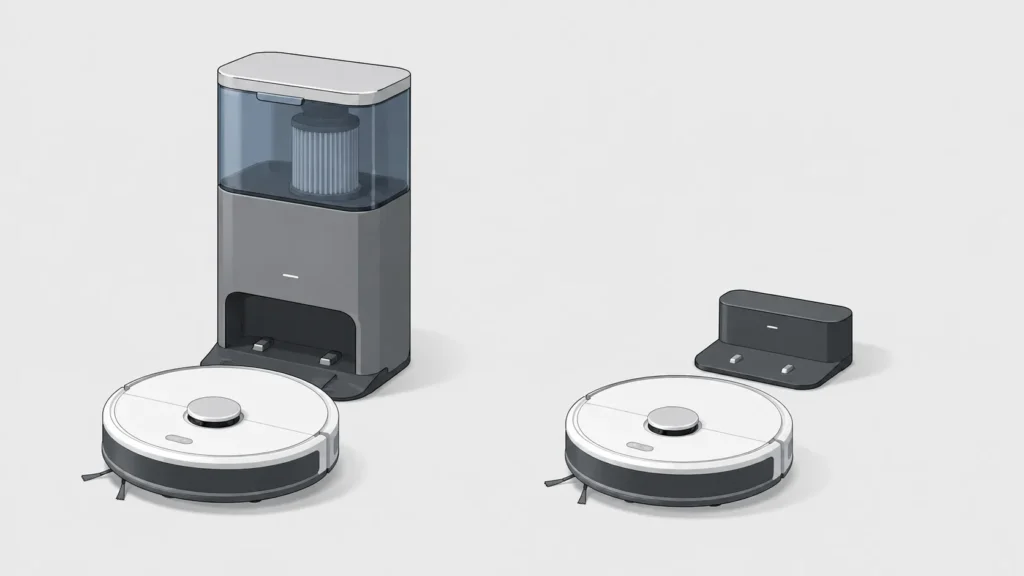
A self-emptying robot vacuum pairs the robot with a dock that includes its own, much larger debris container — usually a bag or bin, sometimes both depending on the model. After a cleaning run, the robot returns to the dock, and the dock’s motor pulls debris out of the robot’s small internal bin into the dock’s larger container. The robot’s own bin is designed to hold roughly one cleaning session’s worth of debris; the dock is designed to hold many sessions’ worth before it needs attention.
For a closer look at exactly how this transfer works mechanically, see How Auto-Empty Robot Vacuum Docks Work.
What “Manual-Empty” Actually Means
A manual-empty robot vacuum is the more traditional setup: the robot has only its own small onboard bin, and its dock is typically just a charging base with no debris-transfer function. When the bin fills up — usually after one to a few cleaning sessions, depending on the size of the space and how much debris it picks up — you remove the bin from the robot by hand, empty it into your household trash, and put it back.
This is the simpler mechanical setup of the two, with fewer moving parts at the dock itself.
Upfront and Ongoing Cost Differences
Self-emptying models generally cost more to buy than an otherwise-comparable manual-empty model, since you’re paying for the dock’s additional motor, container, and debris-transfer mechanism on top of the robot itself. That upfront gap varies a lot by brand and feature tier, so this guide doesn’t cite a specific dollar figure — treat “self-emptying costs more upfront” as a general rule to verify against the specific models you’re comparing, not a fixed number.
On the ongoing side, a self-emptying dock that uses disposable bags adds a small recurring cost for replacement bags, while a bagless self-emptying dock avoids that specific cost but still needs its container emptied by hand periodically (just far less often than a manual-empty robot’s own bin). A manual-empty model has no dock-side consumable cost at all — its only ongoing cost is the same wear-and-tear parts (filters, brushes) that every robot vacuum needs regardless of emptying method.
Maintenance Time: What Changes and What Doesn’t
It’s easy to assume “self-emptying” means “low maintenance” across the board, but that’s not quite accurate. Self-emptying specifically reduces how often you touch the debris bin — it does not reduce how often the robot’s filters, brushes, and sensors need cleaning. Those parts pick up hair, debris, and dust regardless of how the bin itself gets emptied, and skipping their upkeep can affect suction and navigation the same way on either type of robot. For a general sense of what that ongoing upkeep looks like, see Robot Vacuum Maintenance Schedule: What to Clean and Check.
What self-emptying does change is the frequency and unpleasantness of one specific task: emptying the bin. On a manual-empty model, that task happens every session or every few sessions, by hand, often with visible dust exposure. On a self-emptying model, that same task moves to the dock and happens far less often — but it hasn’t disappeared, it’s just been consolidated and delayed.
Noise and Dock Footprint
Self-emptying docks run a small motor for several seconds after each cleaning cycle to pull debris out of the robot, and that process is generally audible — something worth considering if the dock will sit near a bedroom, nursery, or home office. A manual-empty dock is just a charging base, so it doesn’t add this noise at all.
Self-emptying docks are also physically larger than a simple charging base, since they need room for the bigger debris container. If floor or closet space near an outlet is tight, that extra footprint is worth measuring for before buying, not just assuming it will fit.
Dust Bags, Bins, and Replacement Costs
Self-emptying docks generally come in two flavors: bagged, where debris collects in a disposable bag you replace periodically, and bagless, where it collects in a reusable bin you empty by hand. Bagged docks trade a small recurring cost for less direct mess; bagless docks avoid that recurring cost but require slightly more hands-on emptying, though still far less often than a manual-empty robot’s own onboard bin. For a deeper breakdown of this specific choice, see Robot Vacuum Dust Bags for Auto-Empty Docks Explained.
Where Self-Emptying Tends to Help Most
Self-emptying tends to make the biggest practical difference in homes that generate a lot of debris between cleanings — households with pets that shed heavily, larger floor areas that would otherwise mean emptying a small bin multiple times per session, or anyone who specifically finds the emptying task unpleasant enough that reducing its frequency is worth the added cost and dock footprint. If you’re weighing an upgrade from a basic model specifically because emptying the bin has become the most annoying part of ownership, this is the scenario self-emptying is designed to solve. If that describes your situation, What to Know Before Buying a Robot Vacuum With an Auto-Empty Dock covers the buying considerations in more depth once you’ve decided self-emptying is the direction to go.
Where Manual-Empty May Be Enough
Manual-empty tends to be genuinely sufficient for smaller apartments, lighter debris loads, or anyone who doesn’t mind a quick, occasional bin-emptying task in exchange for a simpler, less expensive, and more compact setup. If dock space is tight or dock noise is a concern, skipping the self-emptying feature avoids both issues entirely, and the money saved upfront can often go toward other features (like better navigation or mopping) instead.
Self-Emptying vs. Manual Robot Vacuum: Comparison at a Glance
| Factor | Self-Emptying | Manual-Empty |
|---|---|---|
| Upfront cost | Generally higher | Generally lower |
| How often you empty debris by hand | Every few weeks (dock container) | Every session or few sessions (robot’s own bin) |
| Ongoing consumable cost | Replacement bags, if bagged dock | None dock-side |
| Dock noise | Brief motor noise after each run | None (charging only) |
| Dock footprint | Larger | Smaller |
| Filter/brush/sensor maintenance | Still required, unchanged | Still required, unchanged |
Common Mistakes When Comparing the Two
- Assuming self-emptying means low-maintenance overall. It only changes the bin-emptying task — filters, brushes, and sensors need the same attention either way.
- Not checking dock footprint before buying. Self-emptying docks are noticeably larger than a simple charging base.
- Ignoring recurring bag costs on a bagged self-emptying dock when comparing total cost of ownership, not just the sticker price.
- Assuming a specific dollar amount or “X days between empties” figure applies universally — these vary by model, household debris, and floor area, so treat any such number from a listing as model-specific, not a general rule.
Frequently Asked Questions
Is a self-emptying robot vacuum worth it?
It depends on your situation. It tends to be worth it for households with heavy debris loads (pets, larger floor areas) or anyone who specifically dislikes frequent bin-emptying. For lighter debris loads or tighter budgets and dock space, a manual-empty model can be genuinely sufficient.
Does a self-emptying robot vacuum need less maintenance overall?
No, not overall — it reduces how often you empty the bin specifically, but filters, brushes, and sensors still need regular cleaning on either type of robot.
Are self-emptying docks loud?
They generally make brief, audible motor noise for a few seconds after each cleaning cycle while transferring debris. A manual-empty charging dock makes no such noise.
Can I switch from a manual-empty robot to a self-emptying setup later?
Usually only by buying a robot and dock designed to work together as a self-emptying system — most manual-empty robots aren’t compatible with an auto-empty dock sold separately. Check compatibility with your specific model before assuming an upgrade is possible.
Final Takeaway
Self-emptying vs manual robot vacuum isn’t really a “better vs worse” comparison — it’s a trade-off between paying more upfront (plus a larger dock and occasional bag cost) to empty debris by hand far less often, versus a simpler, cheaper, more compact setup that asks you to empty a small bin more frequently. Neither option changes the maintenance that every robot vacuum needs regardless of emptying method. Matching the choice to your actual debris load, budget, and available dock space matters more than assuming one type is automatically the right answer.