Quick Answer
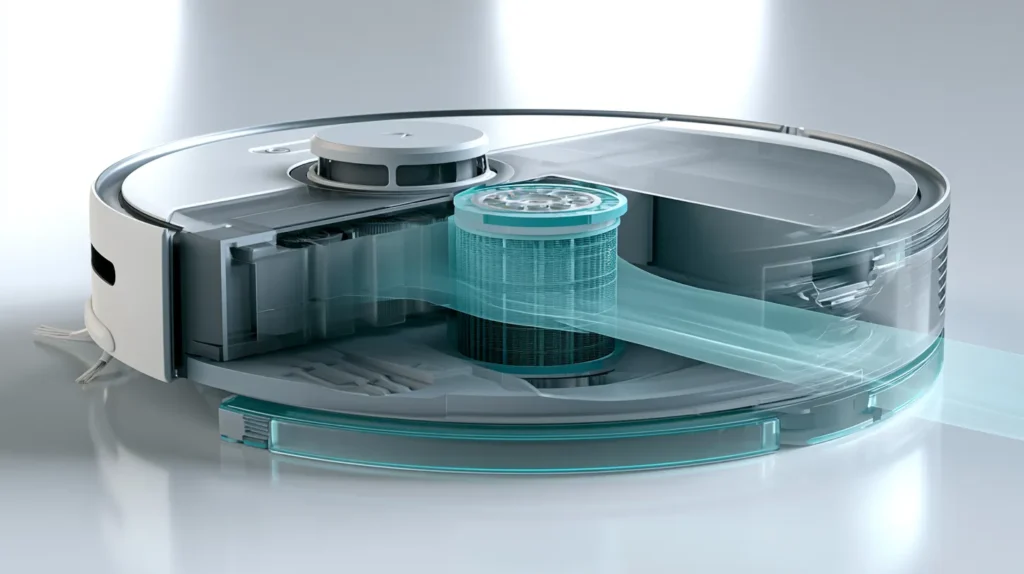
A robot vacuum filter sits in the airflow path between the dustbin and the exhaust vent. As the robot cleans, it pulls in air along with dirt and debris. The dustbin catches the bulk of that debris, but the filter traps the fine particles — dust, pet dander, pollen — before the air is released back into the room. Over time, the filter clogs and needs regular cleaning and eventual replacement to keep suction working at full strength.
Table of Contents
- What a Robot Vacuum Filter Does
- Robot Vacuum Filter Types Explained
- Why Robot Vacuum Filters Clog and Lose Effectiveness
- Signs Your Robot Vacuum Filter Needs Replacing
- Can You Wash a Robot Vacuum Filter?
- Robot Vacuum Filters and Indoor Air Quality
- Frequently Asked Questions
- Final Takeaway
Quick Glossary
- HEPA — High-Efficiency Particulate Air; a filter classification defined by a specific particle-capture performance standard.
- HEPA-style / HEPA-type — Marketing terms used by manufacturers to indicate higher-grade filtration than a standard mesh filter. These labels are not certified to the True HEPA standard.
- True HEPA — A filter that meets the certified standard: it captures at least 99.97% of particles at 0.3 microns. Independent lab certification is required to verify this label.
- Pre-filter — A coarser first-stage filter layer in multi-layer systems that catches larger particles before they reach the finer main filter.
- Filter media — The physical material inside a filter — fibrous or mesh layers — that traps particles as air passes through.
What a Robot Vacuum Filter Does
Most people picture a robot vacuum as something that collects dirt into a bin. That is partly true — but the dustbin is only half the picture. Understanding how your robot vacuum filter works starts with understanding where the filter fits and what the robot is doing beyond simply filling that bin.
When a robot vacuum runs, the motor generates suction that pulls air in through the cleaning head. That airstream carries dirt, hair, and fine particles along with it. The larger debris is captured in the dustbin. But the air itself continues moving through the robot’s internal airflow path and eventually exits through an exhaust vent.
Without a filter in that path, fine particles — things too small for the dustbin to retain — would travel with the air and exit through the exhaust back into the room. The filter sits in that path specifically to prevent that from happening.
Where the Filter Sits in the Airflow Path
The filter is positioned between the dustbin and the motor or exhaust vent. The exact location varies by model — some robots integrate the filter directly into the dustbin assembly, while others have a separate filter compartment accessed from a different part of the robot. But the function is consistent across designs: after the dustbin captures the bulk of the debris, the remaining airstream passes through the filter before leaving the robot.

Think of it as a two-stage capture system: the dustbin catches what it can, and the filter catches the fine particles the dustbin cannot hold.
What the Filter Captures — and What It Doesn’t
A filter in good working condition traps fine particles that pass freely through the dustbin’s mesh — things like fine household dust, pet dander and hair fragments, pollen, and other small airborne debris that becomes airborne again when disturbed.
What the filter does not do is equally important to understand. The robot only filters the specific air being pulled through it during a cleaning run. Fine particles already floating freely in your room air — particles the robot never vacuumed up — are not affected. The filter is treating the robot’s own exhaust stream, not the room’s ambient air the way a dedicated air purifier would.
Robot Vacuum Filter Types Explained
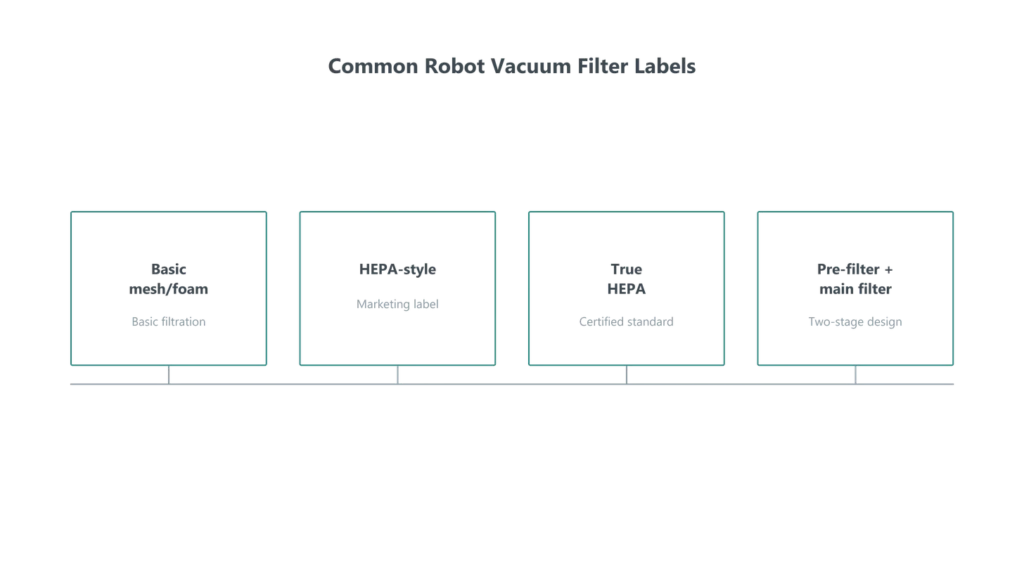
Not all robot vacuums use the same type of filter, and understanding the main robot vacuum filter types helps make sense of what manufacturers are actually describing when they use terms like “HEPA” on product pages or packaging. The differences are real, but the terminology is often used loosely.
Standard Filters
The most basic type is a flat or pleated mesh or foam element. Standard filters prevent visible dust and larger fine particles from reaching the motor, but they are not designed to capture very fine particles reliably.
You will typically find standard filters in entry-level robot vacuums and older designs. They are usually straightforward to clean by tapping or gentle brushing and tend to be the least expensive to replace. For a home with smooth hard floors and no significant dust or pet concerns, a well-maintained standard filter does its job without issue.
HEPA-Style and HEPA-Type Filters
The terms “HEPA-style” and “HEPA-type” appear across a wide range of mid-range robot vacuums. These labels indicate that the filter uses denser fibrous media than a basic mesh — designed to capture finer particles than a standard filter.
The important distinction: these are marketing labels, not certifications. A manufacturer can describe a filter as HEPA-style without any independent testing requirement. The filter may genuinely perform better than a basic mesh filter — and often does — but whether it performs comparably to a certified True HEPA filter depends entirely on the specific product. The label alone does not confirm that.
For most households, HEPA-style filters represent a meaningful step up from standard filters. They tend to trap more of the fine particles that basic filters pass through, which matters in homes with pets or dustier environments.
True HEPA — What the Standard Actually Means
True HEPA is a specific performance standard, not a style or approximation. The US Environmental Protection Agency defines a True HEPA filter as one capable of capturing at least 99.97% of particles at 0.3 microns — the particle size that is hardest to filter, because of the way particles that small behave in an airstream.
When a robot vacuum carries genuine True HEPA certification, that certification should come from independent lab testing, not from the product’s marketing copy.
There is a practical reason True HEPA is less common in robot vacuums than in full-size upright vacuums: True HEPA filter media is denser, which creates more resistance to airflow. Full-size vacuum motors are built to work against that resistance. Robot vacuum motors are smaller and optimized for a different balance of suction, battery efficiency, and noise — designing around True HEPA media involves trade-offs that not all manufacturers choose to make.
If True HEPA filtration matters to your household — for example, when managing significant allergy concerns — look beyond the product label and check whether the filter is backed by independent certification.
Multi-Layer Filter Systems
Some robot vacuums use a two-stage approach: a coarser pre-filter catches the larger fine particles first, and a finer main filter handles the smaller particles. These two components may be separate removable parts or built into a single combined unit, depending on the model.
The pre-filter acts as a buffer — it reduces the particle load reaching the main filter, which extends the main filter’s effective life and keeps it operating closer to its rated capacity for longer. If your robot uses a two-part filter system, both components need separate attention during cleaning and replacement.
Whether your robot uses a single filter or a two-part system is model-specific. Check your manual or your model’s parts diagram to understand what your robot has.
Why Robot Vacuum Filters Clog and Lose Effectiveness
A new filter works efficiently because its pores are open and clear. Every cleaning session sends more particles into the filter media. Over time, those particles accumulate and begin to block the pores.
How Particles Build Up in Filter Media
The clogging process is gradual and mostly invisible at first. Fine particles embed themselves in the fibrous layers of the filter — not just on the surface, but throughout the depth of the media. As more pores become blocked, the motor has to work harder to pull the same volume of air through the filter. The result is reduced suction effectiveness: the robot may leave more fine dust on floors it used to handle cleanly, or struggle to pick up light debris it previously managed without difficulty.
A heavily clogged filter also puts additional strain on the motor over time, because every cleaning run involves fighting increased airflow resistance.
Cleaning vs. Replacing — Why They’re Not the Same
Tapping the filter against a trash can or brushing the surface dislodges loose debris and surface particles. This is worth doing regularly — it extends the filter’s useful life and keeps performance from declining faster than it should.
But cleaning does not restore a filter that has accumulated deeply embedded fine particles. Once fine particles are lodged within the filter media, they cannot be knocked out. They have become part of the filter’s structure. A filter that has been cleaned many times but still looks grayish or continues to produce a faint dusty smell from the exhaust has reached the point where cleaning is no longer making a meaningful difference.
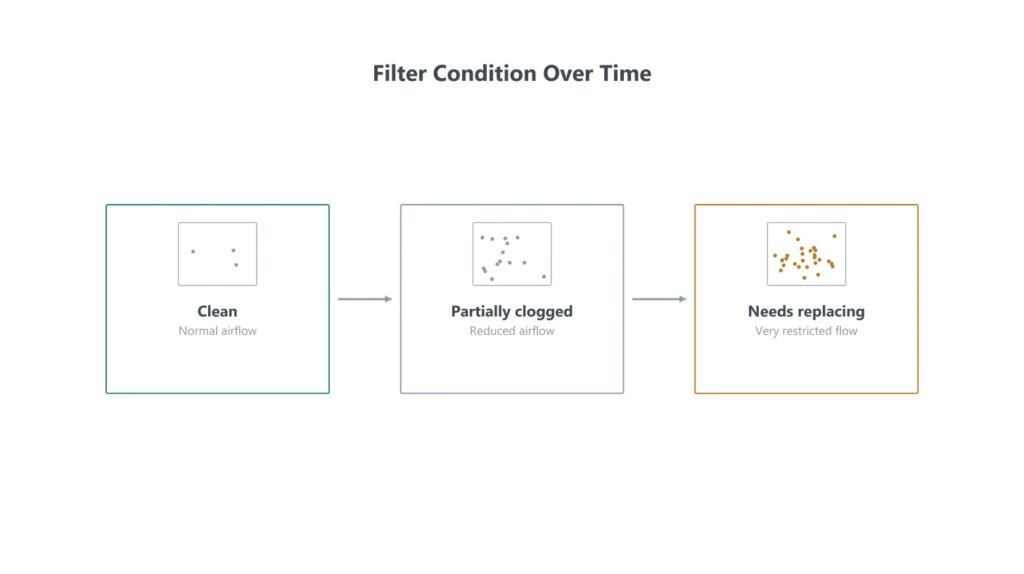
This is the distinction that catches many robot vacuum owners off guard: a clean-looking filter and a still-effective filter are not always the same thing. Replacement is not primarily about appearance. It is about whether the filter’s pores are still clear enough to do their job.
Signs Your Robot Vacuum Filter Needs Replacing
These signals indicate that cleaning alone is no longer enough and that replacement is due:
- Suction feels noticeably weaker even right after cleaning the filter. If the robot is leaving more debris than usual and cleaning the filter didn’t help, the filter is likely the cause.
- A dusty or musty smell from the exhaust after cleaning. Odor-bearing particles embed in filter media over time and cannot be removed by tapping or brushing. A persistent exhaust smell after cleaning is a reliable replacement signal.
- Visible gray or brown discoloration that doesn’t clean off. Some surface discoloration after use is normal. Coloring that remains after a thorough cleaning indicates that the embedded particle load has built up past what cleaning can address.
- Physical damage — tearing, bending, or a compromised seal. A damaged filter allows unfiltered air to pass around the media rather than through it, which defeats the filter’s purpose entirely.
- The manufacturer’s recommended replacement interval has been reached. Your manual specifies the replacement schedule for your model. Use that as a baseline and treat the performance signals above as practical checkpoints alongside it.
Replacement intervals vary by brand, model, and how often the robot runs. Homes with pets or higher dust levels will generally need more frequent replacement than the manual’s baseline interval. For a general framework covering all major robot vacuum components, how often to replace robot vacuum parts walks through the replacement decision across the full maintenance picture.
Can You Wash a Robot Vacuum Filter?
The answer depends entirely on your specific model. There is no universal rule that applies to all robot vacuum filters.
Some manufacturers allow or even recommend rinsing certain filters under running water. Others explicitly state that the filter must not be washed — water can damage fine fibrous filter media, causing it to lose its effectiveness or structural integrity even after it appears to have dried out.
Caution: Do not assume your robot vacuum filter is washable. Some filter types — particularly those that use fine fibrous HEPA-style media — can be permanently damaged by water even if they look and feel normal after drying. Always check your model’s manual before rinsing any filter. If your manual does not specifically say the filter is washable, treat it as tap-and-brush only.
If your manual does permit rinsing, allow the filter to dry completely before reinstalling it. Running the robot with a damp filter can cause damage to the motor over time.
Robot Vacuum Filters and Indoor Air Quality
What the Filter Does — and What It Doesn’t
A well-maintained robot vacuum filter prevents fine particles from being expelled back into the room through the robot’s exhaust. That is a real benefit. During every cleaning run, a functioning filter is keeping the robot’s exhaust cleaner than it would be without one.
What the filter is not doing is treating your room’s air in a broad sense. The robot only processes the air pulled through its cleaning head during a run. Fine particles already suspended in the room — particles the robot never vacuumed up — are unaffected by the robot’s filter.
This distinction matters because some product marketing blurs the line between “robot vacuum with a HEPA filter” and “air purifier.” They are different tools. A dedicated air purifier continuously circulates and filters the room’s air through a HEPA element. A robot vacuum filters only the specific airstream passing through it while it is cleaning. One is a room-air treatment; the other is a floor-cleaning tool with a filtered exhaust.
A Note for Allergy-Aware Households
For households where fine particle capture matters — homes with pets, high-dust environments, or members with dust or pollen sensitivity — filter type and filter condition are both worth paying attention to.
A HEPA-style or True HEPA filter captures finer particles than a standard mesh filter, which reduces the particle load in the robot’s exhaust. Keeping the filter clean and replacing it on schedule means the filter continues performing at the level it was designed for, rather than progressively declining.
That said, a robot vacuum with any filter type is not a substitute for a dedicated air purifier when managing airborne allergens is a health priority. The robot contributes to cleaner floors and a cleaner exhaust stream — a useful part of regular home maintenance — but the room’s overall air quality depends on more variables than the robot’s filter alone.
Fitting filter cleaning and replacement into a consistent routine is the most reliable way to get the benefit the filter is designed to provide. A good starting point is building it into your overall robot vacuum maintenance schedule, which covers all components together.
Frequently Asked Questions
How often should I clean my robot vacuum filter?
Cleaning frequency depends on your model and how often the robot runs. Many manufacturers recommend cleaning the filter every one to two weeks for daily use, or monthly for lighter use. Homes with pets or high dust levels typically need more frequent cleaning. Check your manual for the recommended cleaning interval for your specific model.
How often should I replace my robot vacuum filter?
Replacement intervals are model-specific and listed in your manual. As a practical guide, replace the filter when suction remains weak after cleaning, when you notice a persistent musty smell from the exhaust, or when the filter shows permanent discoloration — whichever comes first. For a broader look at replacement timing across all robot vacuum components, how often to replace robot vacuum parts covers the full framework.
Can I use my robot vacuum without a filter?
It is not recommended. The filter protects the motor from fine particle buildup and prevents those particles from being expelled back into the room. Running the robot without a filter over time can contribute to motor wear, and it eliminates the robot’s ability to trap fine dust during normal cleaning.
Does a HEPA filter make a robot vacuum better?
A HEPA-style or True HEPA filter captures finer particles than a standard mesh filter, which is relevant for households concerned about fine dust, pet dander, or pollen in the exhaust stream. Whether that difference matters day-to-day depends on your home environment. A well-maintained standard filter handles everyday debris effectively for most homes.
My robot still smells after I cleaned the filter. What does that mean?
A persistent smell after cleaning usually means the filter media has absorbed odor-bearing particles that cannot be removed by tapping or brushing. This is a reliable signal that the filter has reached the end of its effective life and needs to be replaced, not cleaned again.
Are all robot vacuum filters the same size?
No — filter size, shape, and attachment method are model-specific. Always use the replacement filter recommended for your specific model. A filter that does not form a proper seal in its housing allows unfiltered air to bypass the media, which defeats the filter’s purpose.
Will a denser filter reduce my robot vacuum’s suction?
Denser filter media creates more airflow resistance, which is one reason True HEPA is less common in robot vacuums. HEPA-style filters designed for robot vacuums are generally built to balance filtration quality with the airflow requirements of the robot’s motor. Whether a specific filter noticeably affects your model’s suction is model-specific — check user reports for your model if this is a concern.
Final Takeaway
The filter in your robot vacuum is not a passive part — it actively determines what goes back into the room air after every cleaning run.
Understanding the difference between standard, HEPA-style, and True HEPA filters helps you read product descriptions more accurately. But filter type matters less than filter condition: a well-maintained standard filter consistently outperforms a neglected HEPA-style one.
The practical steps are straightforward. Clean the filter regularly — your manual specifies the interval. Replace it when the performance signals appear: reduced suction after cleaning, a persistent exhaust smell, or discoloration that won’t clean off. Check your manual before rinsing, because washability is model-specific.
For a step-by-step guide to the cleaning process itself, how to clean your robot vacuum filter covers the full procedure including the dustbin. A maintained filter means a robot running at the capacity it was designed for.